A connected alarm can give your household more time to react by sounding throughout the home when one unit detects smoke or carbon monoxide. The best setup depends on your wiring, floor plan, and whether you want replaceable or long-life batteries.
We compared 10 interconnected smoke detectors, including hardwired, wireless, smoke-only, and combination smoke-and-CO options, to help you choose a practical whole-home alert system.
Best 10 Interconnected Smoke Detectors Picks for 2026
Best Wireless Value

- Wireless alerts sound all units together
- 10-year sealed lithium battery
- Smoke and CO detection in one alarm
Best For: Six-alarm wireless installations without rewiring
Best Hardwired Coverage

- 120V hardwired operation with 9V backup
- Interconnects up to 12 alarms
- Silence mode lasts up to 10 hours
Best For: Larger homes with existing compatible wiring
Best Compact Starter Set

- Three wireless combination alarms
- 10-year sealed lithium battery
- Large bracket helps cover old marks
Best For: Smaller homes and targeted coverage areas
Best Whole-Home Wireless Range

- Links up to 18 alarms over 820 feet
- Dual smoke and CO sensors
- 10-year sealed lithium battery
Best For: Multi-story homes and detached structures
Best Modern Design
Heiman Wireless Interconnected Smoke Alarm 3-Pack

- Wireless alarms sound together across connected units
- Dual-photoelectric sensing and UL 217 10th Edition certification
- Battery powered with mounting screws and magnetic adhesive pads
Best For: Compact, app-free coverage in apartments, rentals, and smaller homes
Best Smoke and CO Coverage
X-Sense Interconnected Smoke and CO Detector 6-Pack

- Detects smoke and carbon monoxide in each unit
- Sealed lithium battery provides up to 10 years of power
- Wireless alarms sound together throughout the home
Best For: Large or multi-level homes needing combined smoke and CO protection
Best Expandable System
X-Sense SD20-W Interconnected Smoke Detector 6-Pack

- Connects with up to 18 compatible Link+ alarms
- Sealed 10-year battery reduces maintenance
- Photoelectric sensor with self-check and one-button hush
Best For: Expanding smoke-only protection across larger or multi-level homes
Whole-Home CO Protection

- Wireless interconnected smoke and CO alarms
- Sealed 10-year lithium battery
- UL 217 and UL 2034 certified
Best For: Homes needing smoke and carbon monoxide coverage without rewiring
Large-Home Smoke Coverage

- Six wireless interconnected smoke alarms
- Connects up to 18 compatible alarms
- Sealed 10-year batteries and photoelectric sensing
Best For: Larger homes needing coverage across several rooms and floors
Essential Multi-Room Coverage
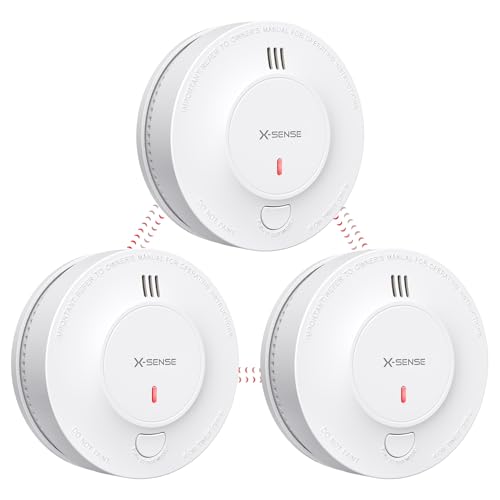
- Three wireless interconnected smoke alarms
- Up to 10 years of sealed-battery power
- Photoelectric sensing with no-wiring installation
Best For: Smaller homes or targeted coverage of key rooms
Best Wireless Value – X-Sense SC06-W 6-Pack
The X-Sense SC06-W is a practical choice if you need interconnected smoke detectors without adding new wiring. Its wireless RF connection makes all six smoke and carbon monoxide alarms sound together, while the sealed 10-year battery reduces maintenance.
Best For: Homes needing a six-alarm, wireless smoke-and-CO system with simple wall or ceiling installation.
Pros:
- Wireless interconnection requires no rewiring.
- Sealed lithium battery is designed to last 10 years.
- Combines photoelectric smoke and electrochemical CO detection.
- One button tests or silences all interconnected units.
Cons:
- Does not support Wi-Fi or a base station connection.
- Battery-powered design is not hardwired.
With six units, UL 217 and UL 2034 certification, and included mounting hardware, the SC06-W offers straightforward whole-home coverage for buyers prioritizing easy installation.
Best Hardwired Coverage – Siterlink GS562A 8-Pack
The Siterlink GS562A is a hardwired option for shoppers replacing or expanding a 120V AC smoke alarm system. Up to 12 alarms can interconnect, so an alarm in one area can trigger every connected unit, while the 9V backup battery helps maintain operation during outages.
Best For: Larger homes that already have compatible 120V wiring and need an eight-alarm interconnected setup.
Pros:
- Hardwired 120V AC operation includes 9V battery backup.
- Supports interconnection of up to 12 alarms.
- UL 217 9th edition-compliant sensing is designed to reduce nuisance alarms from cooking fumes and water vapor.
- Silence mode can mute the alarm for up to 10 hours.
Cons:
- Requires 120V wiring, making installation less flexible than wireless models.
- The supplied notes do not specify a sealed long-life backup battery.
The GS562A makes the most sense when hardwired installation is already available and broad interconnected coverage matters more than cordless setup.
Best Compact Starter Set – X-Sense XP0H-WN 3-Pack
The X-Sense XP0H-WN is a convenient three-pack for adding interconnected smoke detectors to a smaller home, apartment, or targeted area. Each battery-powered unit combines smoke and CO detection, and all linked alarms sound simultaneously when one detects danger.
Best For: Smaller installations that need wireless smoke-and-CO coverage with minimal maintenance.
Pros:
- Three alarms provide an accessible starter configuration.
- 10-year sealed lithium battery avoids frequent replacements.
- Wireless interconnection requires no hardwiring.
- Large 5.7-inch mounting bracket can cover old screw holes and ceiling marks.
Cons:
- Only three alarms are included.
- Does not support Wi-Fi or a base station.
- The large bracket may not suit every existing mounting location.
For buyers who do not need a full six- or eight-unit package, the XP0H-WN delivers the essential combination of wireless alerts, smoke detection, and CO protection in a manageable set.
Best Whole-Home Wireless Range – X-Sense SC01-W 6-Pack
The X-Sense SC01-W is designed for broad wireless coverage across a multi-story home. It links up to 18 alarms over a stated 820-foot range, while dual sensors provide smoke and carbon monoxide detection and a sealed 10-year battery keeps maintenance low.
Best For: Multi-level homes, basements, and detached garages that need expansive wireless interconnection.
Pros:
- Wireless network supports up to 18 alarms and an 820-foot range.
- All connected alarms sound when one detects smoke or CO.
- Dual photoelectric and electrochemical sensors provide combination protection.
- 10-year sealed lithium battery eliminates routine battery swaps.
Cons:
- Does not support Wi-Fi.
- Battery-powered rather than hardwired.
- Six-unit package may be more than needed for smaller spaces.
The SC01-W stands out among these interconnected smoke detectors when wireless reach and expandable whole-home coverage are the primary priorities.
Best Modern Design – Heiman Wireless Interconnected Smoke Alarm 3-Pack
The Heiman S1-R is a compact option for shoppers seeking interconnected smoke detectors without Wi-Fi or app connectivity. Its alarms communicate wirelessly with one another, so all connected units sound when one detects smoke. Dual-beam photoelectric sensing, included lithium batteries, and multiple mounting options make it practical for apartments, rentals, and homes where rewiring is undesirable.
Best For: Buyers who want a small, battery-powered three-pack with wireless whole-home alerts and a modern design.
Pros:
- Wireless interconnection range reaches up to 656 feet in open areas.
- Dual-photoelectric detection is designed to identify faint and slow-smoldering smoke while helping reduce nuisance alarms from steam or cooking.
- UL 217 10th Edition certified, with a lithium battery included and no wiring required.
- Test/Silence control, magnetic adhesive pads, and an 85 dB alarm support straightforward installation and use.
Cons:
- Does not connect directly to a smartphone app or Wi-Fi.
- The three-pack may provide less coverage than larger multi-room kits.
- Its listed operating temperature and humidity limits should be considered during placement.
This is a focused choice for smaller homes or targeted room coverage. Choose it when compact size, current UL 217 certification, and wireless alarm-to-alarm communication matter more than app features or carbon monoxide detection.
Best Smoke and CO Coverage – X-Sense Interconnected Smoke and CO Detector 6-Pack
The X-Sense SC07-W combines interconnected smoke detection with carbon monoxide monitoring in a six-pack. These interconnected smoke detectors communicate wirelessly rather than through Wi-Fi, and when one unit detects smoke or dangerous CO, all connected alarms sound. A sealed 10-year lithium battery and included mounting hardware simplify whole-home installation.
Best For: Families seeking six wireless alarms that cover both smoke and carbon monoxide without routine battery replacement.
Pros:
- Smoke and CO detection in one alarm, using photoelectric and electrochemical sensors.
- Sealed lithium battery is designed to last up to 10 years.
- All interconnected units sound together, including when danger begins on another floor.
- UL 217 and UL 2034 certified, with an 85 dB alarm and included mounting hardware.
Cons:
- Supports wireless interconnection but does not offer Wi-Fi connectivity.
- It is a six-pack rather than a smaller starter set, which may exceed the needs of compact spaces.
- The sealed battery is not designed for user replacement.
For broad coverage, the SC07-W offers more than smoke-only interconnected smoke detectors by adding CO detection to every unit. Its maintenance-free battery and six-alarm configuration are especially useful for multi-level homes.
Best Expandable System – X-Sense SD20-W Interconnected Smoke Detector 6-Pack
The X-Sense SD20-W is a smoke-only six-pack designed for expandable wireless coverage. These interconnected smoke detectors sound together when one detects smoke and can pair with up to 18 compatible X-Sense Link+ alarms, including select SC and SD models. A sealed 10-year battery, self-check function, and one-button hush keep routine maintenance simple.
Best For: Homeowners building a larger X-Sense Link+ system across bedrooms, hallways, and multiple floors.
Pros:
- Supports expansion to up to 18 compatible X-Sense Link+ alarms.
- Sealed lithium battery provides up to 10 years of power without regular replacements.
- Photoelectric sensing helps reduce nuisance alarms from steam and cooking fumes.
- Automatic self-checking and one-button test/hush controls support convenient upkeep.
Cons:
- It detects smoke only and does not include carbon monoxide sensing.
- Compatibility is centered on X-Sense Link+ alarms and accessories.
- The optional remote is needed to test or hush alarms from a distance.
This kit makes the most sense when you want to start with six smoke alarms and expand later. It offers useful system-building flexibility, but shoppers wanting CO monitoring in the same device should consider a combination smoke-and-CO model instead.
Whole-Home CO Protection – X-Sense SC07-W 3-Pack
If you want interconnected smoke detectors that also monitor for carbon monoxide, the X-Sense SC07-W 3-Pack combines wireless whole-home alerts with dual-sensor detection. When one unit detects smoke or dangerous CO, all connected alarms sound together. Its sealed 10-year battery and included mounting hardware also simplify installation and upkeep.
Best For: Homes needing interconnected smoke and carbon monoxide protection without rewiring.
Pros:
- Smoke and CO alarms sound together across interconnected units.
- Sealed lithium battery is designed to last up to 10 years.
- Photoelectric and electrochemical sensors, LCD display, and UL 217/UL 2034 certification.
- Includes mounting brackets, screws, and anchor plugs for installation.
Cons:
- Supports wireless interconnection but does not offer Wi-Fi or remote alerts.
- Only three alarms are included in this package.
The SC07-W is a practical choice when CO detection is as important as smoke detection. Choose it over a smoke-only set if you want dual-purpose coverage and can work within its non-Wi-Fi design.
Large-Home Smoke Coverage – X-Sense SD19-W 6-Pack
For larger homes, these interconnected smoke detectors provide six photoelectric alarms that sound together when one detects smoke. The SD19-W system can connect up to 18 compatible X-Sense Link+ alarms, while sealed 10-year batteries and no-wiring installation reduce routine maintenance.
Best For: Larger homes that need broad smoke-alarm coverage across bedrooms, hallways, and multiple floors.
Pros:
- Six alarms help cover multiple rooms and floors.
- Can connect up to 18 compatible X-Sense Link+ alarms.
- Sealed lithium batteries provide up to 10 years of power.
- Photoelectric sensing, self-test, and one-button test/silence support everyday use.
Cons:
- Smoke detection only; carbon monoxide detection is not listed.
- Optional remote is needed for more convenient testing and silencing of connected alarms.
This six-pack is a strong fit when you want extensive smoke coverage and room to expand the network. It is less suitable if you also need built-in CO monitoring.
Essential Multi-Room Coverage – X-Sense SD19-W 3-Pack
The X-Sense SD19-W 3-Pack offers a smaller, straightforward set of interconnected smoke detectors for essential multi-room coverage. Each photoelectric alarm can trigger the others, and the sealed 10-year batteries make installation quick without wiring or regular battery changes.
Best For: Smaller homes, apartments, or targeted coverage of key rooms and hallways.
Pros:
- All interconnected alarms sound when one detects smoke.
- Three-alarm package supports basic multi-room protection.
- Sealed 10-year lithium batteries reduce maintenance.
- Can connect with up to 18 compatible X-Sense Link+ alarms.
Cons:
- Smoke-only design does not include carbon monoxide detection.
- Three alarms may not be enough for larger homes.
- Optional remote is required for more convenient connected-alarm control.
This package balances interconnected functionality with a manageable quantity for smaller spaces. If you need coverage throughout a larger property, the six-pack provides more units from the same SD19-W family.
How We Picked the Best Interconnected Smoke Detectors
We focused on the features that matter most for a dependable home alarm network: interconnection method, smoke and carbon monoxide sensing, power source, battery lifespan, alarm coverage, installation requirements, and package size. We also included both wireless and hardwired models because the right choice depends heavily on the home’s existing wiring and how much installation work you want to do.
Combination units can provide broader protection with fewer devices, while smoke-only alarms may be a better fit when separate carbon monoxide detectors are already installed. Products with multiple pack sizes also make it easier to outfit apartments, single-story homes, or larger multi-level properties.
Quick Comparison
- Best for broad coverage: Combination smoke-and-CO packs offer two types of detection in one device.
- Best for new or replacement wiring: Hardwired interconnected alarms can integrate with compatible household circuits and often include battery backup.
- Best for simpler installation: Wireless models avoid running signal cable between alarms.
- Best for less maintenance: Ten-year battery models reduce routine battery changes, though the entire alarm generally needs replacement when the sealed battery expires.
- Best for flexible expansion: Choose a system whose alarms use the same compatible interconnection network and can be paired according to the manufacturer’s limits.
Key Buying Factors for Interconnected Smoke Detectors
Wireless or Hardwired Interconnection
Wireless alarms are usually easier to add to finished rooms, older homes, and spaces where opening walls is impractical. Hardwired models are appropriate when compatible wiring already exists or during a renovation. Do not assume alarms from different brands can interconnect; check compatibility before mixing products.
Smoke-Only or Smoke-And-CO Detection
Combination alarms can simplify placement in bedrooms, hallways, and living areas, but they do not replace careful carbon monoxide coverage near fuel-burning appliances or sleeping areas. Follow the manufacturer’s placement instructions and local safety requirements.
Power and Maintenance
Replaceable-battery alarms can keep working with a fresh battery after several years, while sealed ten-year units reduce maintenance. Hardwired products may still require backup batteries. Test every alarm regularly, keep vents clear, and replace units at the end of their service life.
Coverage, Controls, and Alerts
Consider the number of floors, bedrooms, and enclosed areas you need to protect. Look for clearly labeled test and hush controls, low-battery warnings, and an alarm volume suitable for sleeping occupants. A larger pack may cost less per unit, but only if every detector has an appropriate installation location.
Who Should Buy Which Interconnected Smoke Detectors?
Choose a wireless combination pack if you want whole-home smoke and CO coverage without rewiring. Choose a hardwired pack for a compatible existing system or a remodel where electrical installation is already planned. Choose a ten-year battery model if minimizing battery changes is your priority. Choose smoke-only alarms when you already have dedicated CO protection or need to expand an existing smoke alarm network.
Before purchasing, confirm the exact model’s interconnection limits, mounting requirements, replacement schedule, and local code compatibility. Install alarms on every level and outside sleeping areas as recommended by fire-safety authorities, and test the complete network after installation.