The best wireless smoke detectors make it easier to create dependable whole-home fire protection without running new wiring. The products in this roundup range from basic battery alarms to interconnected smoke-and-CO systems with gateways and long-life batteries.
Use the buying guide below to compare alarm types, installation requirements, battery choices, and the features that matter most for your home.
Best 10 Wireless Smoke Detectors Picks for 2026
Best Wireless Combo Protection

- Interconnected smoke and CO alerts
- Sealed 10-year lithium battery
- No Wi-Fi or base-station support
Best For: Homes wanting linked smoke and CO alarms without smart monitoring
Best Simple Kitchen-Friendly Option

- Designed to reduce cooking nuisance alarms
- Front-access 9V battery compartment
- Test/silence and end-of-life warnings
Best For: Basic smoke-only protection with convenient maintenance
Best Smart Whole-Home System

- Six interconnected alarms plus gateway
- Optional phone and email alerts
- 10-year batteries with photoelectric sensing
Best For: Large properties needing scalable local and remote alarm notifications
Best Value Photoelectric Pack

- Five standalone photoelectric alarms
- 85dB-plus audible alarm
- Replaceable 9V batteries and test/mute button
Best For: Multi-room coverage on a budget
Best Whole-Home Combo Coverage

- Wireless smoke and CO interconnection
- 10-year sealed lithium battery
- Supports up to 18 alarms
Best For: Multi-story homes needing coordinated smoke and CO alerts
Best Smoke-Only Linked System

- Connected alarms sound together
- 10-year sealed battery
- Expandable to 18 compatible alarms
Best For: Whole-home smoke-only protection
Best Standalone Combo Alarm

- Smoke and CO detection in one unit
- LCD shows CO levels and battery status
- 10-year sealed battery
Best For: Standalone room-by-room smoke and CO protection
Best Whole-Home Coverage

- Interconnected alerts throughout the home
- Sealed 10-year lithium battery
- Photoelectric smoke sensing
Best For: Larger homes needing coordinated smoke alerts
Best Smoke and CO Combo

- Smoke and CO detection in one unit
- 10-year sealed lithium battery
- Wireless interconnected alerts
Best For: Homes seeking combined smoke and CO protection
Best Compact Starter Set
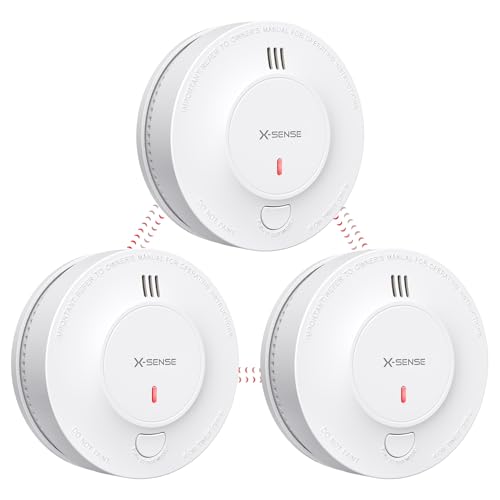
- Three coordinated smoke alarms
- Up to 10-year built-in battery
- No-wiring installation
Best For: Smaller homes and targeted room coverage
Best Wireless Combo Protection – X-Sense XP0H-WN 3-Pack
The X-Sense XP0H-WN is a practical choice for shoppers seeking wireless smoke detectors with carbon monoxide protection. Its three alarms wirelessly interconnect so all units sound together, while sealed 10-year lithium batteries reduce routine maintenance. Note that this model does not use Wi-Fi and cannot connect to a base station.
Best For: Homes needing interconnected smoke and CO coverage without hardwiring or app connectivity.
Pros:
- Smoke and carbon monoxide detection in one alarm.
- Wireless interconnection makes all linked alarms sound together.
- Sealed 10-year lithium battery minimizes battery changes.
- Large mounting bracket can cover old screw holes and ceiling marks.
Cons:
- No Wi-Fi or base-station compatibility.
- The 5.7-inch bracket may not suit every existing installation.
With ETL listing and stated UL 217 and UL 2034 compliance, this three-pack offers straightforward whole-home alerting for buyers who prioritize long battery life over smart-home features.
Best Simple Kitchen-Friendly Option – First Alert SMI100 3-Pack
The First Alert SMI100 is a straightforward battery-powered option among wireless smoke detectors. Its Precision Detection sensing is designed to reduce cooking nuisance alarms, and the front-access battery compartment makes routine replacement easier.
Best For: Buyers who want a simple three-pack for basic smoke protection and easy battery access.
Pros:
- Precision Detection technology is designed to reduce cooking nuisance alarms.
- Battery operation supports easy installation.
- Front-access battery compartment simplifies replacement.
- Test/silence button and end-of-life warning support maintenance.
Cons:
- Smoke-only protection; carbon monoxide detection is not listed.
- No wireless interconnection or smart monitoring is specified.
- Uses a replaceable 9V alkaline battery.
This three-pack is best suited to shoppers seeking uncomplicated smoke alarms rather than a connected whole-home system. Check the manufacture date shown on the product when evaluating replacement timing.
Best Smart Whole-Home System – Heiman S1-R 6-Pack + Gateway
The Heiman S1-R kit is a more advanced choice for wireless smoke detectors, combining six interconnected alarms with a gateway. Without Wi-Fi, the alarms can trigger together locally; with the included gateway and a 2.4GHz Wi-Fi network, the system can send smartphone or email alerts.
Best For: Larger homes, apartments, offices, landlords, and contractors seeking interconnected alarms with optional remote notifications.
Pros:
- Six alarms and one gateway provide broad initial coverage.
- All linked alarms sound when one detects smoke.
- Gateway supports smartphone and email notifications over 2.4GHz Wi-Fi.
- 10-year CR123A battery and dual-beam photoelectric sensing are designed to reduce maintenance and nuisance alarms.
Cons:
- Smart alerts require gateway setup and a 2.4GHz Wi-Fi network.
- More components and configuration than a basic standalone alarm.
- The supplied notes do not provide the complete mounting details.
For buyers who want wireless smoke detectors that can scale into a broader safety network, this kit offers local interconnection plus optional app-based monitoring. Its stated UL 217 10th Edition certification and 10-year warranty add appeal for larger installations.
Best Value Photoelectric Pack – SITERWELL GS509A 5-Pack
The SITERWELL GS509A is a practical five-pack for shoppers comparing affordable wireless smoke detectors with replaceable batteries. Its photoelectric sensor is intended to detect slow-smoldering fires, while the included mounting hardware supports wall or ceiling installation.
Best For: Homes needing multiple standalone photoelectric alarms with a low upfront cost and replaceable batteries.
Pros:
- Five alarms provide coverage for multiple rooms.
- Photoelectric sensing targets slow-smoldering fires.
- Audible alarm exceeds 85dB, according to the supplied notes.
- Test/mute button, low-battery warning, and mounting hardware are included.
Cons:
- Uses replaceable 9V batteries rather than a sealed 10-year battery.
- Wireless interconnection and smart alerts are not listed.
- Weekly testing and ongoing battery replacement are required.
This pack makes sense when you need several standalone alarms and prefer photoelectric detection. It offers useful maintenance alerts and flexible mounting, but buyers seeking all-alarm interconnection should consider a different model.
Best Whole-Home Combo Coverage – X-Sense SC01-W 6-Pack
For shoppers comparing wireless smoke detectors, the X-Sense SC01-W 6-pack stands out when you want smoke and carbon monoxide protection that communicates across multiple floors. Each unit uses a sealed 10-year battery and supports wireless interconnection, though it does not offer Wi-Fi.
Best For: Multi-story homes, basements, and detached garages needing interconnected smoke and CO coverage.
Pros:
- Smoke and CO alerts sound across connected alarms when one detects danger.
- Sealed lithium battery provides up to 10 years of power without routine battery swaps.
- Supports up to 18 alarms across a stated wireless range of up to 820 feet.
- Photoelectric and electrochemical sensors help detect smoke and carbon monoxide.
Cons:
- Does not provide Wi-Fi connectivity.
- Designed for wireless mounting rather than hardwired installation.
This is a strong choice for broad, coordinated coverage in a larger home, especially if you want a combo alarm and long-term battery convenience without wiring.
Best Smoke-Only Linked System – X-Sense SD20-W 6-Pack
If you are looking for wireless smoke detectors throughout the home, the X-Sense SD20-W provides linked, smoke-only protection with a sealed 10-year battery. When one compatible alarm detects smoke, the connected alarms sound together, helping distribute alerts across bedrooms, hallways, and multiple levels.
Best For: Homes wanting expandable, interconnected smoke alarms without carbon monoxide detection.
Pros:
- All connected alarms sound together when smoke is detected.
- Sealed lithium battery lasts up to 10 years.
- Can pair with up to 18 compatible X-SENSE Link+ alarms.
- Photoelectric sensing, self-checking, and one-button hush support everyday usability.
Cons:
- Smoke-only design does not detect carbon monoxide.
- Expansion requires compatible X-SENSE Link+ alarms.
The SD20-W is a practical fit for buyers prioritizing interconnected smoke coverage and low maintenance. Choose a combo model instead if CO detection is also required.
Best Standalone Combo Alarm – X-Sense SC07 5-Pack
For shoppers who want wireless smoke detectors without setting up an interconnected system, the X-Sense SC07 combines smoke and carbon monoxide detection in a standalone alarm. Its LCD displays battery status and real-time CO readings, while the sealed battery is designed to last 10 years.
Best For: Rooms or homes needing straightforward, standalone smoke and CO alarms with visible CO readings.
Pros:
- Combines photoelectric smoke and electrochemical CO detection.
- LCD shows battery level and real-time carbon monoxide levels in PPM.
- Sealed lithium battery provides 10 years of continuous power.
- Mounts on a wall or ceiling with the included hardware.
Cons:
- Does not support wireless interconnection or Wi-Fi.
- Cannot be used with a base station.
- Standalone alarms do not provide whole-home linked alerts.
The SC07 offers useful local information through its LCD and avoids routine battery changes. It is best suited to buyers who do not need alarms to communicate with one another.
Best Whole-Home Coverage – X-Sense SD19-W 6-Pack
If you need wireless smoke detectors for several rooms or floors, this six-pack provides interconnected photoelectric alarms with a sealed 10-year lithium battery. When one detects smoke, all connected units sound, helping alerts reach bedrooms, hallways, and living areas.
Best For: Whole-home smoke protection where long battery life and interconnected alerts are priorities.
Pros:
- Interconnects up to 18 compatible X-Sense Link+ alarms.
- Sealed battery lasts up to 10 years without routine replacement.
- Photoelectric sensing is designed to reduce nuisance alarms from cooking fumes and steam.
- No wiring is required, and installation includes screws and anchor plugs.
Cons:
- Provides smoke detection only, not carbon monoxide detection.
- Wireless interconnection is limited to compatible X-Sense Link+ alarms.
This is a practical six-alarm package for larger homes that want coordinated alerts and minimal battery maintenance. Its UL 217 listing and one-button test/silence function add useful everyday reassurance.
Best Smoke and CO Combo – X-Sense SC06-W 6-Pack
For shoppers comparing wireless smoke detectors with broader protection, this six-pack combines photoelectric smoke sensing with electrochemical carbon monoxide detection. The units interconnect without rewiring, so one alarm triggers all connected alarms.
Best For: Homes wanting interconnected smoke and carbon monoxide monitoring in one alarm.
Pros:
- Combines smoke and carbon monoxide detection.
- Sealed lithium battery provides up to 10 years of power.
- Wireless interconnection makes alerts sound across the system.
- UL 217 and UL 2034 certified, with an 85 dB alarm.
Cons:
- Does not support Wi-Fi or connection to a base station.
- It is battery powered rather than hardwired.
- Offers fewer smoke-only sensing options than a dedicated smoke detector.
The SC06-W is a strong choice when replacing separate smoke and CO alarms with one coordinated system. Its main limitation is that wireless connectivity stays local to the alarms rather than extending to Wi-Fi or a base station.
Best Compact Starter Set – X-Sense SD19-W 3-Pack
This three-pack is a convenient way to add wireless smoke detectors to key areas without buying a larger whole-home bundle. The photoelectric alarms interconnect so every unit sounds when one detects smoke, and their built-in batteries are designed to last up to 10 years.
Best For: Smaller homes, apartments, or targeted coverage in bedrooms and hallways.
Pros:
- Three interconnected alarms provide coordinated smoke alerts.
- Built-in battery helps avoid regular battery changes for up to 10 years.
- Photoelectric sensing may reduce nuisance alarms from cooking fumes and steam.
- Installs without wiring and includes mounting hardware.
Cons:
- Smoke detection only; carbon monoxide detection is not included.
- Three alarms may be insufficient for larger or multistory homes.
- Compatibility is centered on X-Sense Link+ alarms.
This package suits buyers who need a smaller starting configuration or coverage for a few priority locations. It retains the core interconnected-alert and low-maintenance features of the SD19-W line while avoiding the size of a six-pack.
How We Picked These Wireless Smoke Detectors
We selected these Wireless Smoke Detectors to represent the main options homeowners are likely to consider: standalone battery alarms, interconnected multi-packs, combination smoke and carbon monoxide detectors, and smart systems that use a gateway. We focused on practical factors such as alarm communication, battery longevity, included accessories, pack size, installation flexibility, and suitability for different home layouts.
Before buying, verify that each model is approved for use in your region and install it according to the manufacturer’s instructions. Wireless interconnection is useful, but it does not eliminate the need for correct placement, testing, and regular maintenance.
Quick Comparison
| Best For | What to Look For |
|---|---|
| Basic protection | Standalone smoke alarm with a clear test and hush button |
| Whole-home coverage | Interconnected multi-packs so one alarm can trigger the others |
| Fire and CO monitoring | Combination smoke and carbon monoxide detection |
| Long-term convenience | Sealed 10-year battery and a clearly stated product life |
| Smart alerts | Gateway-based connectivity and compatible app notifications |
Key Buying Factors for Wireless Smoke Detectors
Interconnection and Range
Interconnected alarms can provide earlier warning throughout the home because multiple units sound when one detects danger. Confirm how the system communicates, whether all alarms are compatible with one another, and whether the wireless range suits your walls, floors, and building materials.
Smoke-Only Versus Combination Alarms
Smoke-only models are suitable when you already have separate CO protection. Combination units add carbon monoxide monitoring in one device, which can simplify placement and maintenance. They may be especially useful near sleeping areas, utility rooms, and rooms with fuel-burning appliances, subject to local safety guidance.
Battery Type and Maintenance
Sealed 10-year batteries reduce battery changes and help prevent alarms from being disabled because of low-battery chirps. Replaceable-battery models can be more economical initially, but they require a consistent testing and replacement schedule. Test every alarm regularly and replace units at the end of their rated service life.
Pack Size and Placement
Count the locations that need protection before choosing a pack. Consider bedrooms, hallways, each level, and areas near—but not inside—kitchens. A larger pack can lower the per-unit cost, while a smaller pack may be better for an apartment, guesthouse, or targeted upgrade.
Who Should Buy Which Wireless Smoke Detectors?
Choose a basic battery alarm if you need simple protection for one room or a small space. Pick an interconnected smoke-only set for a larger home where simultaneous alarms are the priority. Combination smoke-and-CO models are the better fit when you want broader hazard coverage from fewer devices.
Consider a gateway-based smart system if remote notifications and connected-home features are important to you. For rental properties, second homes, or anyone who wants less routine maintenance, sealed 10-year battery models offer a convenient option. Regardless of the model, use enough alarms for your layout, keep them unobstructed, and test the complete system after installation.