A smart lock without Wi-Fi can provide convenient keyless entry without cloud accounts, wireless networking, or the added complexity of a connected home system. These locks typically use PIN codes, fingerprints, touchscreens, or traditional backup keys.
We’ve rounded up 10 options for different priorities, from simple keypad deadbolts to biometric models and standalone locks with temporary-code features. Use the guide below to compare security features, installation needs, battery requirements, and everyday usability before choosing one.
Best 10 Smart Lock Without Wifi Picks for 2026
Best Upgrade-Ready Pick
Yale Assure Touchscreen Deadbolt
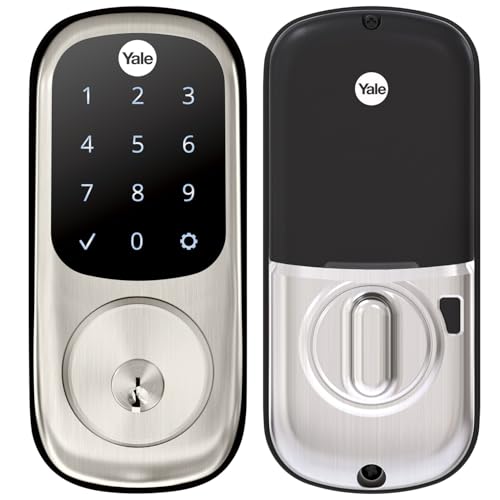
- Touchscreen code entry
- Auto-lock feature
- Optional Yale Access upgrade
Best For: Homeowners wanting keypad access with a future connected upgrade
Best Fingerprint Option
TEEHO TE002 Fingerprint Deadbolt

- Stores fingerprints and passcodes
- Includes one-time PIN support
- IP54-rated weather resistance
Best For: Households wanting biometric entry without connected features
Best Keypad Handle Set

- No app, Wi-Fi, or Bluetooth
- Stores up to 20 access codes
- Includes passage and auto-lock modes
Best For: Homes and rentals needing shared keypad access with a handle
Best Budget Keypad Lock

- 20 user codes plus a one-time guest PIN
- Up to 365-day battery life with low-battery alert
- IP54-rated design with backup keys
Best For: Simple code-based entry without WiFi or an app
Best for Everyday Use
DESLOC B200 Biometric Deadbolt

- Fingerprint unlocking in under 0.3 seconds
- Supports up to 50 fingerprints and multiple backup methods
- Bluetooth control with optional gateway features
Best For: Fast biometric entry without relying on WiFi
Best Feature-Rich Door Knob

- Eight entry methods, including fingerprint and keypad
- App-based users, schedules, codes, and activity logs
- Up to 16 months of battery life with emergency USB-C power
Best For: Shared spaces, rentals, and multi-user access management
Best for Custom Access

- Supports 50 user codes and 10 one-time codes
- Adjustable auto-lock from 30 seconds to 10 minutes
- Grade 2 BHMA-certified with SmartKey re-keying
Best For: Homes needing many individual access codes
Best Simple Key-Free Pick

- No app, phone setup, or WiFi required
- Stores up to 20 unique entry codes
- Includes auto-lock, backup key, and low-battery alerts
Best For: Straightforward keyless entry without connected features
Best for One-Time Codes

- Generates remotely shareable one-time PIN codes
- Supports 20 permanent user PINs
- Offers privacy mode and adjustable auto-lock
Best For: Homes and hosts managing temporary access
Best Upgrade-Ready Pick – Yale Assure Touchscreen Deadbolt
The Yale Assure is a practical smart lock without Wi-Fi for shoppers who want keypad entry now and the option to add smartphone access later. Its touchscreen supports entry codes, automatic locking, and multiple user codes without requiring the separately sold Yale Access Upgrade Kit.
Best For: Homeowners who want a touchscreen keypad with a future upgrade path.
Pros:
- Uses entry codes instead of physical keys.
- Auto-lock helps ensure the door is secured.
- Designed to fit standard doors from 1-¾ to 2-¼ inches thick.
- Can be upgraded to phone-based access with the Yale Access Upgrade Kit.
Cons:
- Smartphone and smart-home features require a separately sold upgrade kit.
- Doors under 1-⅝ inches require a thin-door kit.
This Yale model is a strong choice if you want a polished touchscreen deadbolt and code sharing today, while keeping open the possibility of adding connected features later.
Best Fingerprint Option – TEEHO TE002 Fingerprint Deadbolt
The TEEHO TE002 delivers several keyless entry methods without an app, Wi-Fi, or Bluetooth connection. For shoppers seeking a smart lock without Wi-Fi, it combines fingerprint access, passcodes, one-time PINs, and backup keys in a weather-resistant deadbolt.
Best For: Busy households, rentals, and users who prefer fingerprint access over phone control.
Pros:
- Supports up to 20 fingerprints and 20 passcodes.
- One-time PINs can provide temporary access to guests.
- Auto-lock, one-touch locking, silent mode, and away mode add convenience.
- IP54 weather resistance and a stated battery life of up to 365 days.
Cons:
- Four AA batteries are required but not included.
- Compatible with 2-⅛-inch door holes only.
- It is a nonconnected lock, so it does not provide remote app access.
With biometric entry and useful access-management features, the TE002 is a versatile offline lock. Confirm the door-hole requirement before buying, especially for an unusual or older door.
Best Traditional Keypad – Schlage Camelot Keypad Deadbolt
The Schlage Camelot is a straightforward smart lock without Wi-Fi for replacing a conventional deadbolt with keypad access. Its illuminated, silicone-coated buttons make code entry easier in the dark, while the included key backup preserves a familiar entry method.
Best For: Buyers who prioritize simple keypad operation, durable construction, and easy installation.
Pros:
- Grade 2/AAA-rated construction is intended for residential and light commercial use.
- Illuminated keypad supports nighttime code entry.
- Designed for DIY installation with only a screwdriver and no hardwiring.
- Includes key backup and a limited lifetime mechanical warranty.
Cons:
- It does not offer Wi-Fi or connected remote-access features.
- Access is based on keypad and thumbturn operation rather than fingerprint entry.
This Schlage is a sensible pick for shoppers who want dependable keyless entry without adding an app or network connection. Its conventional design may also feel familiar to households replacing an existing deadbolt.
Best Keypad Handle Set – NICE DIGI Z1A Keypad Lock
The NICE DIGI Z1A is a smart lock without Wi-Fi that combines a keypad with a door handle. It supports up to 20 personalized codes, temporary one-time codes, auto-lock, and passage mode, making it useful for homes, rentals, offices, and other spaces where shared access is common.
Best For: Standard-door installations that need a keypad handle, shared codes, and passage mode.
Pros:
- Requires no app, Wi-Fi, or Bluetooth connection.
- Stores up to 20 personalized 4–8 digit codes.
- Offers temporary codes, auto-lock, passage mode, and one-touch locking.
- Reversible handle fits left- or right-handed doors and installs with a screwdriver.
Cons:
- Four AA batteries are required but not included.
- Designed for standard wooden doors, so compatibility should be checked before purchase.
- It does not provide remote access or smartphone control.
The Z1A stands out when you need a complete keypad-and-handle setup rather than a standalone deadbolt. Its passage mode is particularly useful for busy periods, rentals, or frequent entry.
Best Budget Keypad Lock – TEEHO TE001 Keypad Deadbolt
If you want a smart lock without WiFi, the TEEHO TE001 provides straightforward keypad entry without requiring an app or internet connection. It supports multiple family codes, a one-time guest PIN, automatic locking, and a traditional key backup.
Best For: Families, renters, and homeowners seeking simple code-based entry for a standard front or back door.
Pros:
- Supports up to 20 individual access codes plus a disposable one-time code.
- Automatic locking can be set from 10 to 99 seconds, with one-touch locking available.
- Runs for up to 365 days on four AA batteries and includes a low-battery indicator.
- IP54 weather resistance, anti-peeping code protection, and two backup keys add practical security.
Cons:
- Batteries are not included.
- Requires a 2-1/8-inch door hole and is not compatible with 38mm holes.
- The lock must be reset before first use to detect door handing.
The TE001 is a practical choice when you want keyless convenience without WiFi complexity. Its main limitation is fit compatibility, so confirm your door measurements before ordering.
Best for Everyday Use – DESLOC B200 Biometric Deadbolt
For shoppers comparing a smart lock without WiFi, the DESLOC B200 offers Bluetooth-based management and several local entry methods. Fingerprints, PINs, key fobs, physical keys, and eKeys give households flexibility, while app features are available nearby through Bluetooth.
Best For: Households that want fast fingerprint access and multiple entry choices without depending on a WiFi connection.
Pros:
- Self-learning fingerprint recognition can unlock in under 0.3 seconds and supports up to 50 fingerprints.
- Offers fingerprint, PIN, app, eKey, key fob, physical key, and optional voice-control access.
- Four AA batteries provide up to 12 months of use, with a low-battery indicator and USB-C emergency power.
- IP54 water resistance and operation from -22°F to 158°F suit varied climates.
Cons:
- Alexa and Google Assistant voice control require the separately sold G2 Gateway.
- Remote app management also requires the G2 Gateway; Bluetooth control is intended for close range.
- Batteries are not included.
The B200 stands out for biometric convenience while retaining several backup access methods. It is a strong fit for users who prefer local Bluetooth control, but gateway-based remote features add an extra purchase.
Best Feature-Rich Door Knob – Veise VE018 Fingerprint Lock
The Veise VE018 is a smart lock without WiFi for shoppers who want a fingerprint door knob with extensive local access options. It combines Bluetooth app management, keypad entry, IC cards, keys, and shareable codes with activity logs and adjustable auto-locking.
Best For: Bedrooms, apartments, home offices, rentals, and households managing guests or multiple users.
Pros:
- Provides eight access methods, including fingerprint, keypad, Bluetooth app, IC card, mechanical key, and shared passwords.
- Stores up to 20 fingerprints and supports more than 100 codes and fobs according to the supplied specifications.
- App features include user permissions, access schedules, activity logs, status checks, and 10- to 180-second auto-lock settings.
- Offers up to 16 months of battery life, low-battery alerts, USB-C emergency power, and two backup keys.
Cons:
- Alexa and Google Assistant, remote control, and notifications require the separately sold Veise G1 Gateway.
- Four AA batteries are not included.
- Installation compatibility should be checked against the required 1-3/8- to 2-inch door thickness and 2-1/8-inch hole.
The VE018 delivers more access-management tools than a basic keypad lock, making it useful for shared spaces and rentals. Its richest remote and voice features depend on an optional gateway, but Bluetooth and local entry methods work without WiFi.
Best for Custom Access – Kwikset SmartCode 260
If you want a smart lock without WiFi, the Kwikset SmartCode 260 provides keyless keypad entry without app or network dependence. It supports extensive code management, auto-lock settings, and a traditional key backup through SmartKey Security.
Best For: Households that need many personalized access codes and configurable automatic locking.
Pros:
- Supports up to 50 user codes, 10 one-time codes, and one programming code.
- Auto-lock can be set from 30 seconds to 10 minutes.
- Grade 2 BHMA-certified security, intrusion alert, Vacation Mode, and SmartKey re-keying.
- Installs with a screwdriver and includes BILT interactive instructions.
Cons:
- Requires four AA alkaline batteries, which are not included.
- Provides local keypad control rather than connected remote access.
The SmartCode 260 is a strong choice when flexible local access matters more than connected features. Its large code capacity and adjustable auto-lock make it especially practical for busy homes.
Best Simple Key-Free Pick – Yale Code Deadbolt
For shoppers seeking a smart lock without WiFi, the Yale Code Deadbolt keeps things simple: install it, create access codes, and use the backlit keypad. It requires no app, phone setup, or network connection.
Best For: Users who want straightforward keyless entry with minimal technology and a backup key.
Pros:
- Works without an app, phone setup, or WiFi.
- Creates up to 20 unique entry codes for household members or guests.
- Includes auto-lock, a backlit keypad, and a backup key.
- Designed for temperatures from -22°F to 140°F and provides low-battery alerts.
Cons:
- Grade 3 BHMA certification is residential-grade rather than the higher Grade 2 rating of some alternatives.
- Offers fewer codes than the Kwikset SmartCode 260.
The Yale Code Deadbolt is a sensible no-network option for anyone who values uncomplicated operation. Its backup key and low-battery alerts add reassurance, while the 20-code capacity covers most everyday household needs.
Best for One-Time Codes – Philips Keyless Entry Lock
The Philips Keyless Entry Door Lock is a smart lock without WiFi that combines touchscreen PIN entry with remotely generated one-time codes. It is designed for standalone use while still making temporary access convenient to share.
Best For: Hosts and homeowners who frequently provide temporary access codes.
Pros:
- Supports one master PIN, 20 permanent user PINs, and one-time PIN codes.
- Generates one-time codes remotely for sharing at any time.
- Offers customizable 30- to 180-second auto-lock and manual locking.
- Includes privacy mode, Away mode alarm, and up to one year of battery life.
Cons:
- Its nonconnected design may not suit shoppers seeking full smart-home integration.
- Remote one-time-code generation is the main connected-style feature described in the supplied specifications.
Choose the Philips when temporary access is a priority but you still want a standalone deadbolt. Its code options and privacy features give it more access flexibility than a basic keypad lock.
How We Picked the Best Smart Lock Without Wifi
We focused on standalone entry locks that do not require a home Wi-Fi connection for normal operation. The selection includes keypad deadbolts, touchscreen models, fingerprint locks, and handle-integrated designs. We considered entry flexibility, backup access, installation compatibility, battery operation, code management, construction details, and the practicality of each lock for common residential doors.
Because features can vary by version, verify the manufacturer’s current specifications before buying. In particular, check whether remote code creation, fingerprint storage, or app-based controls require a separate hub, Bluetooth connection, or optional accessory.
Quick Comparison
| Lock type | Best for | Main advantage |
|---|---|---|
| Keypad deadbolt | Most households | Simple PIN-based entry |
| Fingerprint lock | Fast daily access | No code to remember |
| Touchscreen lock | Modern door designs | Low-profile digital controls |
| Handle lock | Doors using a knob or lever | Integrated entry hardware |
| Keypad with temporary codes | Guests and rentals | More flexible access management |
Key Buying Factors for a Smart Lock Without Wi-Fi
Door and Deadbolt Compatibility
Measure door thickness, backset, bore-hole size, and the distance between the deadbolt and nearby hardware. Confirm that the lock fits your existing setup and that the interior assembly has enough clearance. Handle-integrated models may require different preparation than replacement deadbolts.
Entry Methods and Backup Access
Keypads are generally the simplest option, while fingerprints can speed up daily entry when the sensor reads reliably. A physical key, emergency power connection, or mechanical override is valuable if batteries run out or electronics malfunction. Look for anti-peep keypad features if shoulder surfing is a concern.
Battery Life and Maintenance
Most non-Wi-Fi locks run on replaceable batteries, so check the battery type, low-power warning, and emergency power method. Wi-Fi-free models often conserve energy better than connected locks, but usage, weather, and cold temperatures can still reduce runtime.
Code Management and Security
Consider how many user codes the lock supports and whether codes can be added or deleted directly at the keypad. For homes with cleaners, guests, or renters, temporary or individually assigned codes are more useful than sharing one permanent PIN. Always change factory programming codes during setup.
Who Should Buy Which Smart Lock Without Wifi?
Choose a basic keypad deadbolt if you want affordable keyless entry with minimal setup. A fingerprint model suits busy households that prioritize fast access without carrying keys or remembering codes. A touchscreen design is a good fit for buyers who prefer a cleaner appearance, while a handle lock works best when replacing the entire knob or lever assembly.
If you manage guests or short-term occupants, prioritize a model with multiple user codes or temporary-code support. Buyers who want remote locking, notifications, access logs, or voice-assistant integration should consider a Wi-Fi or hub-connected smart lock instead, since a standalone smart lock without Wi-Fi is designed for local control rather than full remote management.