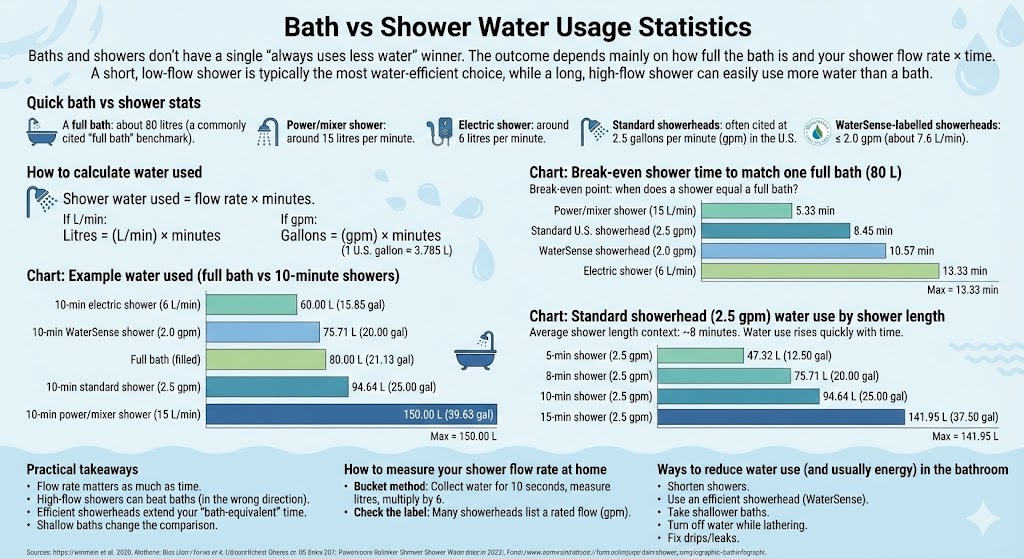
Baths and showers don’t have a single “always uses less water” winner. The outcome depends mainly on how full the bath is and your shower flow rate × time. A short, low-flow shower is typically the most water-efficient choice, while a long, high-flow shower can easily use more water than a bath.
bath vs shower water usage statistics
Quick bath vs shower stats
A full bath: about 80 litres (a commonly cited “full bath” benchmark).
Power/mixer shower: around 15 litres per minute.
Electric shower: around 6 litres per minute.
Standard showerheads: often cited at about 2.5 gallons per minute (gpm) in the U.S.
If your shower is in L/min: Litres = (L/min) × minutes
If your shower is in gpm: Gallons = (gpm) × minutes, then convert if needed (1 U.S. gallon ≈ 3.785 L)
Chart: Example water used (full bath vs 10-minute showers)
This comparison uses a “full bath” benchmark of 80 L and shows how much water a 10-minute shower uses at several common flow rates.
Label
Bar
Value
10-min electric shower (6 L/min)
60.00 L (15.85 gal)
10-min WaterSense shower (2.0 gpm)
75.71 L (20.00 gal)
Full bath (filled)
80.00 L (21.13 gal)
10-min standard shower (2.5 gpm)
94.64 L (25.00 gal)
10-min power/mixer shower (15 L/min)
150.00 L (39.63 gal)
Max = 150.00 L. Widths: 10-min electric shower (6 L/min) 40.00%, 10-min WaterSense shower (2.0 gpm) 50.47%, Full bath (filled) 53.33%, 10-min standard shower (2.5 gpm) 63.09%, 10-min power/mixer shower (15 L/min) 100.00%.
Break-even point: when does a shower equal a full bath?
If you compare to an 80 L full bath, the break-even shower time is:
Break-even minutes = 80 ÷ (your shower flow in L/min)
Chart: Break-even shower time to match one full bath (80 L)
Label
Bar
Value
Power/mixer shower (15 L/min)
5.33 min
Standard U.S. showerhead (2.5 gpm)
8.45 min
WaterSense showerhead (2.0 gpm)
10.57 min
Electric shower (6 L/min)
13.33 min
Max = 13.33 min. Widths: Power/mixer shower (15 L/min) 40.00%, Standard U.S. showerhead (2.5 gpm) 63.40%, WaterSense showerhead (2.0 gpm) 79.25%, Electric shower (6 L/min) 100.00%.
Average shower length context
One commonly cited benchmark is that the average shower lasts about 8 minutes. Paired with typical showerhead flow rates, those minutes add up fast—especially because showers also involve heated water, which increases energy use and cost.
Chart: Standard showerhead (2.5 gpm) water use by shower length
This chart shows how quickly water use rises with time on a common “standard” flow rate.
Flow rate matters as much as time. Two showers of the same length can use very different water depending on the shower type and showerhead.
High-flow showers can beat baths (in the wrong direction). A ~15 L/min shower reaches an 80 L bath in a bit over 5 minutes.
Efficient showerheads extend your “bath-equivalent” time. A 2.0 gpm showerhead reaches 80 L at roughly 10.6 minutes.
Shallow baths change the comparison. If you don’t fill the tub, your bath can use far less than 80 L.
How to measure your shower flow rate at home
Bucket method: Hold a bucket under the shower for 10 seconds, measure the litres collected, then multiply by 6 to get L/min.
Check the label: Many showerheads list a rated flow (often in gpm).
Ways to reduce water use (and usually energy) in the bathroom
Shorten showers: Even 1–2 minutes less can make a noticeable difference, especially on higher-flow setups.
Use an efficient showerhead: Look for WaterSense (U.S.) or other verified efficiency labels where available.
Take shallower baths: Avoid filling the tub higher than you need.
Turn off water while lathering: If practical, pause the flow during shampoo/soap steps.
Fix drips/leaks: Small leaks add up over time and waste heated water if they’re on the hot side.
Sources
Consumer Council for Water (CCW) – “How much water do you use?” https://www.ccw.org.uk/save-money-and-water/averagewateruse/
U.S. EPA WaterSense – Showerheads overview https://www.epa.gov/watersense/showerheads
U.S. EPA – WaterSense Specification for Showerheads (PDF) https://www.epa.gov/sites/default/files/2017-01/documents/ws-products-spec-showerheads.pdf
U.S. EPA WaterSense – “Save Water and Energy by Showering Better” learning resource (PDF) https://www.epa.gov/sites/default/files/2017-02/documents/ws-ourwater-shower-better-learning-resource_0.pdf
UK Government (Environment Agency) – Water efficiency facts (includes shower and bath figures) https://www.gov.uk/government/news/water-efficiency-must-become-national-priority-says-ea