Last updated: February 16, 2026
Cold plunging (cold-water immersion, ice baths, or cold plunge tubs) has moved from elite-sport recovery rooms into mainstream wellness. Below are the most-cited numbers on market growth, usage trends, recovery outcomes, and safety risks.
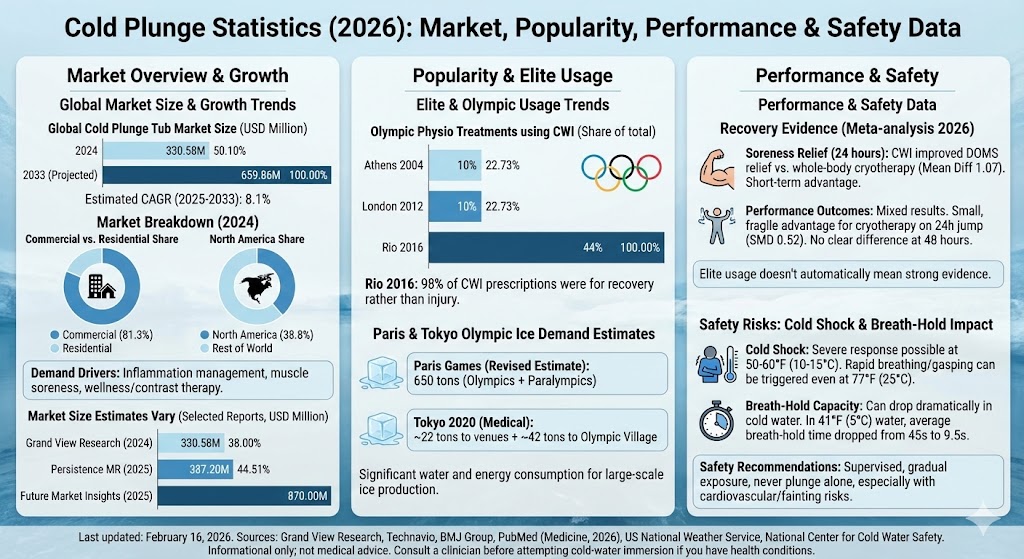
Key cold plunge stats at a glance
- Global cold plunge tub market size (2024): USD 330.58 million.
- Projected global market size (2033): USD 659.86 million (implying the market roughly doubles from 2024 to 2033).
- Estimated market CAGR (2025–2033): 8.1%.
- North America’s market share (2024): 38.8%.
- Commercial share of the market (2024): 81.3% (gyms, wellness centers, hotels, clinics).
- Technavio forecast (2024–2029): market size expected to increase by USD 110.3 million at a 5% CAGR.
- Olympic trend (physio treatments): cold-water immersion accounted for about 10% of treatments at Olympic polyclinics in Athens 2004 and London 2012, rising to 44% by Rio 2016.
- Why it was used at the Olympics (Rio 2016): 98% of cold-water immersion prescriptions were for recovery rather than injury.
- Paris Games ice estimate: initial requests were 1,624 tons of ice (reported cost €2.5 million), later reduced to 650 tons (450 Olympics + 200 Paralympics).
- Tokyo 2020 ice delivery (medical purposes): ~22 tons to venues plus another 42 tons to the Olympic Village residences (with unknown waste).
- Cold shock can be dangerous even above “ice bath” temps: cold shock can be severe at 50–60°F (10–15°C), and rapid breathing/gasping can be triggered by water as warm as 77°F (25°C).
- Breath-hold impact (cold water safety data): in 41°F (5°C) water, one study reported average breath-hold time dropping from 45 seconds to 9.5 seconds.
- Recovery evidence (meta-analysis): a 2026 systematic review/meta-analysis (13 RCTs, 214 participants) found cold-water immersion improved DOMS relief within 24 hours versus whole-body cryotherapy (reported mean difference 1.07; 95% CI 0.70–1.43), while differences at 48 hours were not statistically significant.
Quick table: cold plunge numbers people cite most
| Metric | Figure |
|---|---|
| Global market size (cold plunge tubs), 2024 | USD 330.58M |
| Projected global market size, 2033 | USD 659.86M |
| Commercial market share, 2024 | 81.3% |
| North America market share, 2024 | 38.8% |
| Olympic physio treatments using CWI (Rio 2016) | 44% |
| Paris ice estimate after revision (Olympics + Paralympics) | 650 tons |
| Cold shock hazard: water temp range | 50–60°F (10–15°C) |
Chart 1: Global cold plunge tub market size (USD million)
| Label | Bar | Value | ||
|---|---|---|---|---|
| 2024 |
| 330.58 | ||
| 2033 (projected) |
| 659.86 |
Max = 659.86. Widths: 2024 50.10%, 2033 (projected) 100.00%.
Market breakdown: where demand is concentrated
- Commercial dominates: commercial installations accounted for 81.3% of the market in 2024 (gyms/spas/hotels/clinics).
- North America leads: North America held 38.8% share in 2024.
- Growth is closely tied to recovery: market research commonly cites use cases like inflammation/discomfort management, muscle soreness, and wellness/contrast therapy offerings.
Chart 2: Market size estimates vary (selected reports, USD million)
Different research firms may define the category differently (tubs only vs. broader cold therapy hardware), which is why estimates can spread widely. This chart shows a simple side-by-side of commonly cited headline figures.
| Label | Bar | Value | ||
|---|---|---|---|---|
| Grand View Research (2024) |
| 330.58 | ||
| Persistence MR (2025) |
| 387.20 | ||
| Future Market Insights (2025) |
| 870.00 |
Max = 870.00. Widths: Grand View Research (2024) 38.00%, Persistence MR (2025) 44.51%, Future Market Insights (2025) 100.00%.
Chart 3: Cold-water immersion surged in Olympic recovery rooms
Olympic polyclinic records and commentary in sports medicine highlight how quickly cold-water immersion became “standard” in elite recovery environments.
| Label | Bar | Value | ||
|---|---|---|---|---|
| Athens 2004 |
| 10% | ||
| London 2012 |
| 10% | ||
| Rio 2016 |
| 44% |
Max = 44%. Widths: Athens 2004 22.73%, London 2012 22.73%, Rio 2016 100.00%.
Performance & recovery: what the research says (and what it doesn’t)
- Short-term soreness relief is the most consistent finding. In a 2026 systematic review/meta-analysis (13 RCTs), cold-water immersion outperformed whole-body cryotherapy for DOMS relief within 24 hours (reported mean difference 1.07), but not at 48 hours.
- Performance outcomes are mixed. The same analysis found a small, fragile advantage for cryotherapy on 24-hour jump performance (SMD 0.52), with no clear difference at 48 hours.
- Elite usage doesn’t automatically mean strong evidence. Sports medicine commentary has highlighted that high-volume ice/cold use can outpace the strength of evidence for certain recovery goals.
Safety statistics: cold shock is the main risk mechanism
Cold plunge tubs are usually controlled environments, but the physiological “cold shock” response is real and can be dangerous—especially for people with cardiovascular risks, fainting risk, or anyone plunging alone.
- Cold shock severity: official weather safety guidance notes cold shock can be severe at 50–60°F (10–15°C), and gasping/rapid breathing may be triggered by water as warm as 77°F (25°C).
- Breathing control changes fast: cold water safety guidance cites breath-hold capacity in water below 60°F (15.6°C) dropping to roughly one-third of warm-water ability; one volunteer study example reported a drop from 45 seconds to 9.5 seconds in 41°F (5°C) water.
- Time-in-water guidance (expert opinion reported by news): some experts recommend keeping exposures brief (minutes, not long sits), especially at colder temperatures.
Environmental & operational angle: ice demand can get extreme
- Tokyo 2020: ~22 tons of ice delivered to venues for medical purposes, plus another ~42 tons to Olympic Village residences.
- Paris estimates: initial requests of 1,624 tons were reportedly reduced to 650 tons (with an early cost estimate of €2.5 million tied to the larger request).
- Why this matters: beyond cost, large-scale ice production/storage/transport uses substantial water and energy—one reason sports medicine experts have urged more selective, evidence-based use.
FAQ
Is the cold plunge market actually growing?
Yes. Multiple market research firms forecast growth through the late 2020s and early 2030s, though headline market size estimates vary by what’s included (tubs only vs. broader cold therapy hardware).
What’s the single most “solid” benefit supported by data?
The most repeatable finding across athletic studies is short-term soreness relief (especially within the first 24 hours), while performance and long-term adaptation outcomes are more mixed and context-dependent.
What’s the biggest safety issue?
Cold shock—a rapid, involuntary breathing and cardiovascular response—can increase drowning risk and trigger problems for some individuals. This is why supervised, gradual exposure and avoiding plunging alone are common safety recommendations.
Sources (for the stats above)
- Grand View Research — Cold Plunge Tub Market (2024 size, 2033 projection, CAGR, regional/segment shares)
- Technavio — Cold Plunge Tub Market (forecast increase 2024–2029, CAGR)
- BMJ Group (press release referencing BJSM opinion piece) — Olympic ice volumes, Paris ice estimates, and treatment-share figures
- PubMed (Medicine, 2026) — systematic review/meta-analysis comparing cold-water immersion vs. body cryotherapy
- US National Weather Service — cold water hazards and cold shock temperature triggers
- National Center for Cold Water Safety — cold shock and breath-hold impacts
Informational only; not medical advice. If you have cardiovascular disease, fainting risk, or are pregnant, consult a clinician before attempting cold-water immersion.